


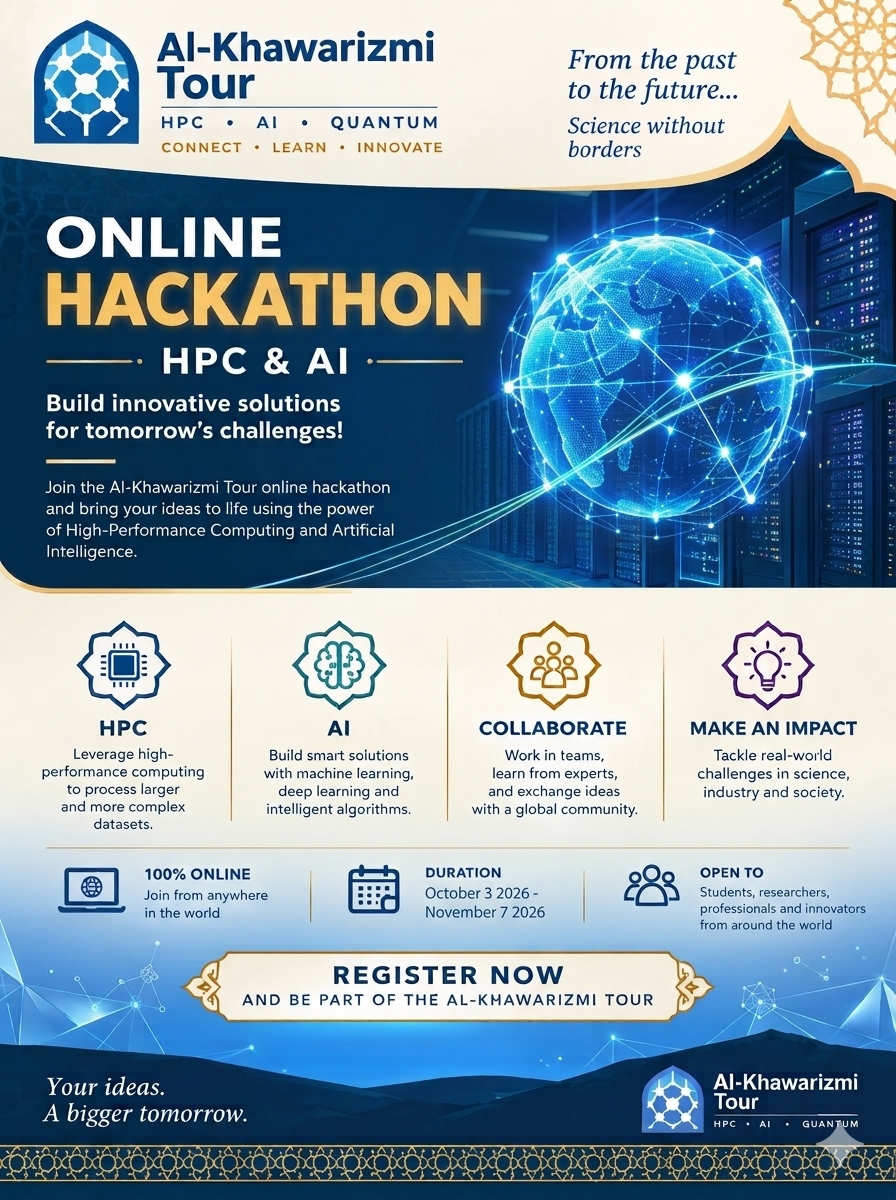
Call For Online Hackathon
October 3 - November 7
Sponsored by:


Al-Khawarizmi Tour 2026
(Registration is now closed)
Online HPC & AI Hackathon — Guidelines
1. Hackathon Schedule
The Al-Khawarizmi Tour 2026 Online Hackathon will take place over six consecutive Saturdays, providing participants with an opportunity to learn, collaborate, develop, and optimize HPC and AI applications.
- Dates: October 3 – November 7, 2026
- Day: Every Saturday
- Time: 4:00 PM – 6:00 PM Saudi Arabia Time (AST, UTC+3)
- Format: Online
- Platform: Zoom (link will be shared later after registration)
- Participation: Open to all levels
- Registration: Mandatory
Each session will combine technical guidance, hands-on development, team collaboration, and challenges designed to introduce participants to the concepts and practices of High Performance Computing (HPC), parallel programming, and Agentic AI.
2. Who Can Participate?
The hackathon is open to everyone, regardless of their previous experience with HPC or AI.
Participants may include:
- High-school students
- Undergraduate students
- Graduate students
- PhD students
- Researchers
- Engineers and developers
- HPC and AI enthusiasts
No prior experience in supercomputing is required. Participants are encouraged to join with an interest in programming, scientific computing, agentic AI, performance optimization, or learning how modern computing systems are used to solve challenging problems.
3. Team Formation
Participants may work individually or form a team.
- Teams may have up to 6 members.
- Participants are encouraged to form multidisciplinary teams combining different skills, such as programming, mathematics, AI, HPC, and scientific applications.
- For student teams, we recommend — but do not require — that team members come from the same school, university, or institution.
- Cross-institutional teams are welcome.
- Participants who do not have a team may be matched with other participants where possible.
For participants interested in the Student Cluster Competition pathway at the ISC27 conference, forming a team within the same institution can be particularly useful for developing a longer-term collaboration and preparing for the competition activities (see Section 7 below for further information).
4. Programming Languages and Frameworks
Solutions developed during the hackathon should primarily use one or more of the following programming environments:
- Python / PyTorch
- C
- C++
- Julia
Participants may use additional libraries and tools where appropriate, particularly for HPC, AI, numerical computing, and performance optimization. Remote access to hardware systems will be provided via the AutoHPC software framework.
Teams are encouraged to focus not only on obtaining a correct solution, but also on understanding performance, scalability, memory usage, parallelism, and computational efficiency.
5. Hackathon Objectives
The hackathon aims to give participants practical experience in:
- Developing HPC and AI applications
- Parallel programming and performance optimization
- Using modern CPU/GPU computing architectures
- Understanding computational and memory bottlenecks
- Applying AI and numerical methods to challenging problems
- Working effectively as a technical team
- Benchmarking and analyzing application performance
- Presenting and communicating technical results
Participants will progressively develop their projects throughout the hackathon and will have opportunities to receive guidance and feedback during the online sessions.
6. Recommended Team Structure
Teams are encouraged to distribute responsibilities among their members. For example:
- Team Leader / Coordinator — coordinates activities and communication
- Algorithm Developer(s) — develops the computational or AI approach
- HPC/Performance Developer(s) — focuses on parallelization and optimization
- Data/AI Developer(s) — handles data processing and AI components
- Benchmarking/Analysis Member — evaluates performance and scalability
- Presentation/Documentation Member — prepares the final technical presentation
A participant may fulfill more than one role, particularly in smaller teams.
7. Student Cluster Competition Opportunity
A major objective of this hackathon is to provide students with an opportunity to gain experience that can serve as preparation for the International Student Cluster Competition (SCC) organized as part of ISC High Performance.
The ISC27 Student Cluster Competition will include both virtual and in-person components, with the virtual competition taking place in spring 2027 and the in-person competition scheduled for June 8–10, 2027.
Eligible and successful student teams participating in the Al-Khawarizmi Tour hackathon may have the opportunity to be considered for virtual participation in the international Student Cluster Competition in 2027.
Participation in the Al-Khawarizmi Tour hackathon does not automatically guarantee selection for the ISC Student Cluster Competition. Selection will depend on eligibility requirements, team composition, technical performance, commitment, and the official ISC/HPC-AI Advisory Council competition procedures.
The official ISC27 Student Cluster Competition information is available at:
ISC High Performance — Student Cluster Competition
8. Recommendations for Student Teams
Students interested in pursuing the Student Cluster Competition pathway are strongly encouraged to:
- Form a team early, ideally with up to six committed student members.
- Preferably recruit members from the same school or university, although this is not mandatory.
- Include students with complementary skills in programming, mathematics, AI, systems, and HPC.
- Identify a team coordinator who can organize meetings and communication.
- Maintain regular collaboration between the weekly hackathon sessions.
- Document the team’s technical work, performance results, and individual contributions.
- Develop strong skills in Linux, C/C++, Python/PyTorch, parallel programming, benchmarking, and performance analysis.
- Be prepared to continue working together after the hackathon if selected for further competition activities.
9. Participation Expectations
Participants are expected to:
- Attend ALL the online sessions.
- Actively contribute to their team.
- Respect other participants and team members.
- Share knowledge and collaborate constructively.
- Follow the technical and submission requirements communicated during the hackathon.
- Ensure that submitted work is their team’s own work and appropriately acknowledges any external software, datasets, or resources used.
10. What You Will Gain
By participating in the Al-Khawarizmi Tour 2026 Online Hackathon, participants will have the opportunity to:
Learn → Build → Optimize → Compete
You will gain hands-on experience in HPC and AI, work with an international community of students and enthusiasts, work on a practical technical project, and potentially take the next step toward participating in an international Student Cluster Competition.
No matter your level of experience, build a team, come with passion, learn new skills, and start computing!
11. Request for a Certificate of Participation
Certificates will be awarded only to participants who actively participate in the online hackathon. To be eligible, participants must attend the required webinar lectures and submit the assigned homework within the specified deadlines. Participants who do not meet the attendance and homework submission requirements will not be eligible to receive a certificate of participation.